A gravity furnace heats a house without a fan. Warm air leaving the heat exchanger is less dense than the surrounding air, so it rises on its own through large ducts and out of floor or wall registers. Cool air, being heavier, sinks back down through return ducts to the furnace body. The entire system runs on that density difference, which is why it is called a gravity furnace.
That design is the reason these units are still running in homes built before about 1950. There is no blower motor to burn out, no control board to fail, and very little to go wrong mechanically. That is also why nearly all of them should be replaced. A furnace with no moving parts can keep producing heat long after the one component that matters, the heat exchanger, has stopped being safe.
How a Gravity Furnace Moves Heat Without a Fan
Because convection is a slow, weak force compared to a blower, everything about the system has to be oversized to accommodate it. The ducts are huge, often 12 to 20 inches in diameter, and they run upward on a gentle continuous slope. Any downward dip would trap air and stall the flow. Those thick round ducts branching out from a central body are why these units picked up the nickname octopus furnace.
The heat exchanger is usually heavy cast iron or thick steel, built to hold and radiate heat over long cycles. Combustion exhaust vents by natural draft into a masonry chimney, with no induced draft fan pulling it along. Most of these units were originally coal-fired and were converted to natural gas or oil at some point in their life.
The tradeoff is efficiency. The Department of Energy classifies older, low-efficiency systems in the range of roughly 56 to 70 percent AFUE, and gravity furnaces typically sit at the bottom of that band or below it, near 50 to 60 percent. For every dollar of gas burned, close to half the heat goes up the chimney. Current federal minimums for new gas furnaces start at 80 percent AFUE, and DOE has finalized a rule raising that floor to 95 percent later this decade.
How to Tell If That Is What You Have
Five signs, in order of how quickly you can confirm them:
- No blower. Stand next to the unit while it runs. A gravity furnace makes almost no sound. If you hear no rush of air and feel no vibration, that is the strongest single indicator.
- Oversized round ducts. Ducts wider than a dinner plate, wrapped in insulation, radiating outward from one central body.
- A large cast iron or steel body, often octagonal or drum-shaped, frequently sitting on a brick or concrete base.
- Floor and wall registers rather than ceiling vents. Gravity systems deliver low and return low.
- No air filter, or a token one. These systems were never designed for filtration, because a filter would restrict the weak convective airflow.
If the unit sits under the floor with a single large grate above it, you are more likely looking at a floor furnace, which is a related but different design common in Southern California homes.
What You Can Safely Check Yourself
None of these involve opening the furnace or touching the burner assembly.
- Look at the chimney and vent connector. The pipe running from the furnace to the chimney should be intact, sloping slightly upward, and free of rust holes or gaps at the joints. Rust flakes or soot on the floor beneath that pipe indicate exhaust is not venting cleanly.
- Check that registers and returns are clear. Gravity systems have no fan to overcome an obstruction. Furniture over a floor register or a blocked return will noticeably reduce heat in that room.
- Note whether rooms far from the furnace ever get warm. Weak convection means distant rooms were always the last to heat. If a room that used to warm up no longer does, something in the duct run or the furnace itself has changed.
- Confirm you have working carbon monoxide alarms on every level and near sleeping areas. With any natural-draft appliance, this is not optional, and it matters more with a furnace this old.
If you smell gas, hear a sustained roaring or rumbling from the unit, or see soot around registers, stop and call for service. Do not operate the system while you wait.
What Needs a Technician
- The heat exchanger. This is the whole ballgame. A gravity furnace heat exchanger is decades past its design life, and metal that has expanded and contracted through that many heating cycles develops cracks. On a system with a blower, a crack lets combustion gases mix into supply air under pressure. On a gravity system, the same crack lets those gases drift into rooms on natural convection. The warning signs of a cracked heat exchanger are subtle enough that inspection with proper instruments is the only reliable way to rule it out.
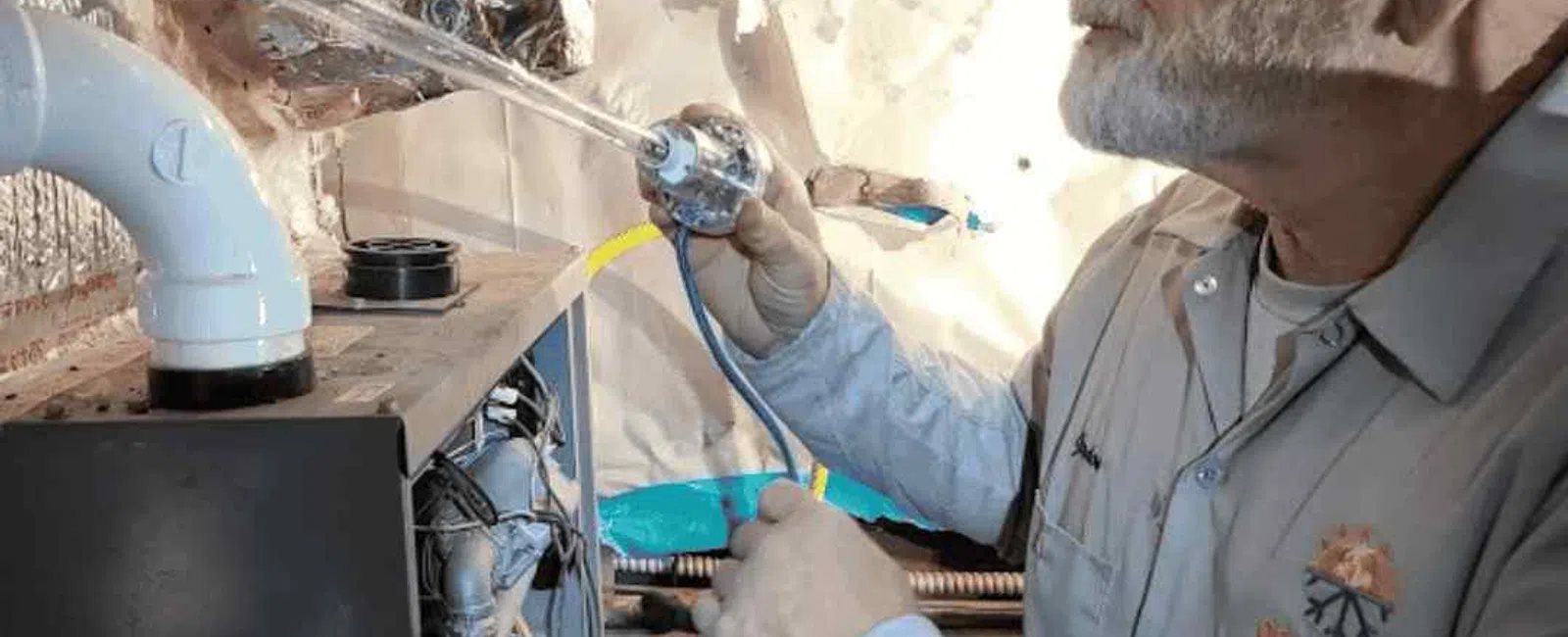
- Draft and combustion testing. A technician measures whether the unit is actually pulling exhaust up the chimney under real operating conditions, and tests carbon monoxide levels in the ambient air and in the flue. A deteriorated chimney liner is common in houses this age and will not be visible from the basement.
- Gas pressure and burner condition. Conversions from coal to gas were sometimes done well and sometimes not. Burner alignment, manifold pressure, and safety controls all need verification against what the unit was actually converted to.
- Anything involving the duct insulation. Insulation wrap on ducts of this era frequently contains asbestos, as does the joint compound at the seams. Intact wrap is generally not hazardous. Disturbing it is. Do not scrape, cut, or pull at it. In California, work disturbing more than 100 square feet of asbestos-containing material requires a contractor registered with the Cal/OSHA Asbestos Contractors' Registration Unit.
When a Gravity Furnace Is Past Repair
| What You Are Seeing | What It Usually Means | The Right Response |
|---|---|---|
| Soot around registers or on the furnace body | Incomplete combustion, possible exchanger or draft failure | Shut it down and call for combustion testing |
| CO alarm sounding, or headaches and nausea that ease when you leave the house | Combustion gases entering living space | Leave the house, call the gas utility, then schedule service |
| Visible cracks, rust-through, or scaling on the exchanger | End of service life, no safe repair path | Replacement, not repair |
| Gas bills far above neighbors with similar homes | Efficiency in the 50 to 60 percent range | Replacement pays back through operating cost |
| Rooms that never reach temperature | Duct runs, undersized capacity, or a failing exchanger | Full system assessment |
| Unit runs fine, no symptoms, 70+ years old | Working on borrowed time | Annual inspection, plan the replacement |
The bottom row is the one homeowners argue with, and it is fair to argue with. A gravity furnace that tests clean is not an emergency. It is a system to plan around rather than react to, which is a much better position than discovering the problem in January.
Why This Looks Different in the South Bay
Most gravity furnace content assumes a basement, because that is where these units sit across the Midwest and Northeast. Southern California largely does not have basements. In Torrance, San Pedro, and the older parts of Long Beach and Redondo Beach, the same era of construction solved heating differently, with floor furnaces dropped between joists and gas wall furnaces set into interior walls. True octopus-style gravity units do exist here, usually in pre-1940 homes with a crawlspace deep enough to hold one, but they are the exception rather than the rule.
What that means practically: if you have identified an old, blower-free gas furnace in a South Bay home, get it looked at rather than assuming it matches what you read online. The venting arrangement, the duct layout, and the conversion history vary a great deal from house to house here.
Coastal air adds a second factor. Salt-laden humidity accelerates corrosion on steel vent connectors and chimney hardware, and we see rust-through on flue piping in beach-adjacent homes noticeably earlier than in inland ones. On a natural-draft appliance with no safety switch to catch a venting failure, that piping is doing real safety work.
One thing we run into often enough to mention: homeowners who assume the old ducts can be reused for air conditioning. They cannot. Gravity ducts are sized for slow convective flow, and cooling requires far higher velocity through much smaller ducts. Anyone quoting you a cheap AC add-on to a gravity system has not looked at the ductwork.
What Replacement Actually Involves
This is a bigger project than a standard furnace swap, and it is worth understanding why before you collect quotes.
The ducts usually cannot be kept. Their diameter, slope, and layout are wrong for any modern forced-air system, and the insulation may need abatement before removal. That means the honest comparison is not furnace against furnace. It is a full forced-air replacement, ducts included, against alternatives that skip ductwork entirely.
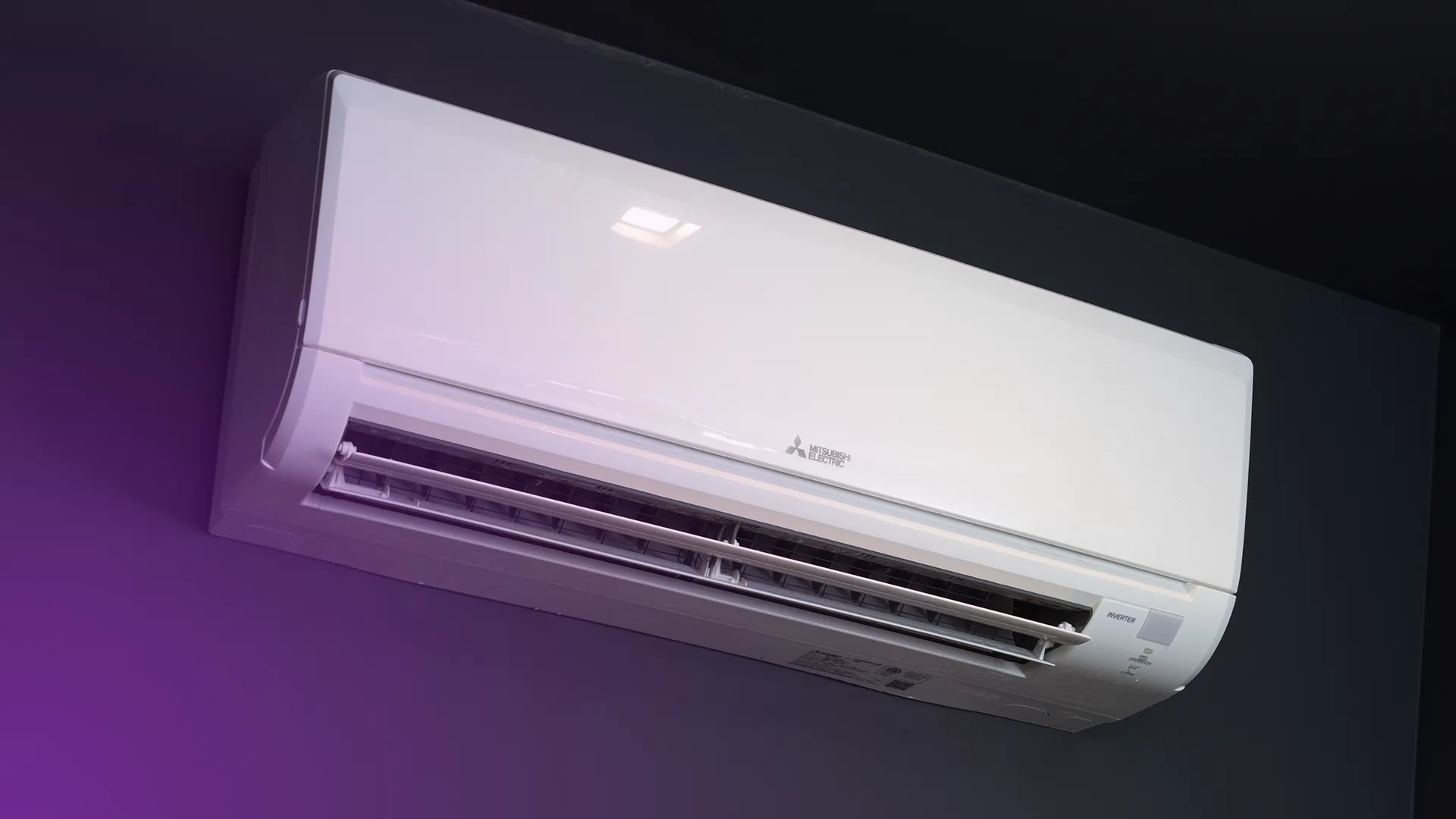
Ductless mini-splits are worth pricing for exactly this reason. In a home where the existing duct system has to come out regardless, removing ducts from the equation can change the math considerably, and it adds cooling that a gravity system could never provide.
Whichever direction you go, insist on a load calculation. Sizing a replacement by matching the old unit's rating is how homes end up with oversized equipment that short cycles, because a 1930s house that has since been insulated and had its windows replaced has a very different heat load than it did when the gravity furnace was installed. ACCA Manual J is the industry standard for that calculation.
Have an Old Furnace in Torrance or the South Bay?
We work on the heating systems that come with older housing stock across Torrance, Redondo Beach, Manhattan Beach, San Pedro, and Long Beach, including gravity units, floor furnaces, and gas wall furnaces that most companies would rather not open up. Our factory-trained technicians test draft, measure carbon monoxide in the flue and in the room, and inspect the heat exchanger with instruments rather than a flashlight and a guess. If the system tests clean, we will tell you that and give you a realistic timeline. If it does not, you will get a straight explanation of what we found and your options for furnace repair or furnace replacement.
There is no service call or trip charge when we complete the repair. Contact us to schedule an inspection before the first cold week of the season.